Category Archives: Culture

Philadelphia

Philadelphia’s Food Scene Heats Up: Wonder and Gather Food Halls Take Over

Philadelphia is getting two new additions to its culinary landscape: Wonder Food Hall and Gather Food Hall. But what exactly is a food hall? Are they just upgraded food courts, or do they offer something truly special? Experts and locals alike are watching to see how these new food halls in Philadelphia will shape the dining scene.

Story Highlights

  • Wonder Food Hall: Fully integrated kitchens, delivery via app, mix-and-match cuisines, rapid expansion.

  • Gather Food Hall: Six curated vendors, focus on local and immigrant-owned businesses, affordable pricing, University City location.

  • Philadelphia Dining Scene: Food halls vary widely; Reading Terminal Market remains an iconic benchmark.

  • Community Impact: Gather provides meals to food-insecure students; Wonder emphasizes convenience and variety.

What Makes a Food Hall?

Annie Allman, CEO of Reading Terminal Market, explains:

“A food hall is a collection of prepared food or dining operators that operate in a shared space.”

While Reading Terminal is technically a public market, Allman’s insight applies broadly. She emphasizes quality, authenticity, consistency, and value as the hallmarks of a successful food hall.

“There’s really only one Reading Terminal Market, and we both constantly evolve and yet always maintain tradition,” Allman said.

Wonder Food Hall: Convenience and Variety

Wonder Food Hall is rapidly expanding in Philly, with locations in Fishtown, South Philly, University City, and Rittenhouse. Founder Mark Lore, a serial entrepreneur, has developed a model unlike traditional food halls: all food is prepared in fully integrated kitchens under Wonder’s supervision.

“Everyone wants something different,” said Jason Rusk, Wonder’s EVP of restaurant operations.
“Some people want pizza, others want Thai, and some want a salad. We give all of that in one order.”

Wonder allows diners to mix and match cuisines — from burgers at Burger Baby to spiced fries from Maydan — all through its app. Celebrity chefs, including Bobby Flay and José Andrés, have helped test and develop menu items.

“When you think about why you go on Amazon, it’s because you can get anything there,” Rusk explained.
“We wanted to create the same experience in food — all variety, all in one place.”

Wonder operates like a ghost kitchen with a physical dine-in space, prioritizing convenience and speed, with most orders delivered under an hour.

Gather Food Hall: Curated Choices and Community

Gather Food Hall, located in the historic Bulletin Building near 30th Street Station, takes a different approach. With six curated vendors, Gather highlights local and immigrant-owned businesses. Featured vendors include Mucho Perú, Sahbyy Food, El Mictlan, Federal Donuts, and Bowl’d Masala.

“Having a variety of options in one central location is ideal for people to explore foods they might not usually eat,” said Emily Uliano, Gather’s PR representative.
“You can walk around on your lunch break and experience a mix of locally rooted international vendors.”

Gather also partners with Believe in Students to provide 5,000 free meals for food-insecure students. Menu items are priced as low as $12 to make them accessible.

“It’s like a culinary destination in University City,” Uliano added.
“People can feel comfortable, safe, and part of a vibrant environment while trying new foods.”

Hospitality HQ co-founders Michael Wetherbee and Chef Akhtar Nawab emphasize supporting first-time and minority business owners.

“Success isn’t always about opening multiple locations,” Wetherbee said.
“It’s about helping local vendors thrive and giving them a platform they couldn’t otherwise afford.”

Challenges for Food Halls

While both Wonder and Gather are optimistic, food halls in Philadelphia face challenges. High operating costs, rising rents, and post-COVID recovery are major hurdles. New York City has seen closures of several food halls in recent years, including Williamsburg Food Hall and Gotham West Market.

“Operating costs have spiked coming out of COVID,” said Allman of Reading Terminal Market.
“We’ve had to focus on fundraising to maintain operations.”

The Future of Philly Food Halls

Despite challenges, Wonder and Gather are carving out distinct niches. Wonder appeals to diners seeking convenience and variety, while Gather emphasizes local culture, affordability, and community engagement.

Reading Terminal Market remains a benchmark, reminding Philadelphia diners that food halls can differ widely in concept, quality, and impact.

Appreciating your time:

We appreciate you taking the time to read our most recent article! We appreciate your opinions and would be delighted to hear them. We value your opinions as we work hard to make improvements and deliver material that you find interesting.

Post a Comment:

In the space provided for comments below, please share your ideas, opinions, and suggestions. We can better understand your interests thanks to your input, which also guarantees that the material we offer will appeal to you. Get in Direct Contact with Us: Please use our “Contact Us” form if you would like to speak with us or if you have any special questions. We are open to questions, collaborations, and, of course, criticism. To fill out our contact form, click this link.

Stay Connected:

Don’t miss out on future updates and articles.

Celebrate Philadelphia History: 52 Weeks of Firsts Across the City

Philadelphia, already celebrated as the birthplace of the nation, is now inviting residents and visitors to rediscover its role as a city of firsts. From the first hot air balloon flight to the first selfie, Philadelphia is marking over 250 years of groundbreaking milestones with a year-long celebration titled “52 Weeks of Firsts.”

Every week throughout 2026, a new event will honor a different Philadelphia first, showcasing the city’s influence on American history, culture, and everyday life. Participants can explore interactive storytelling, scavenger hunts, giveaways, and even oversized foam #1 sculptures marking the original sites—or as close as possible—of these historical achievements.

At the announcement event at the Constitution Center, the festive atmosphere included circus performers, Mummers, Once Upon A Nation Storytellers, and Franklin Fountain ice cream sodas. Amy Needle, president and CEO of Historic Philadelphia, Inc., highlighted the city’s rich legacy:

“Philadelphia has always been a city of firsts — from the founding of our nation to innovations that shaped everyday life. This is an opportunity for residents and visitors alike to explore these firsts and learn about all the amazing history and innovation that has happened in Philadelphia over the last 250 years.”

The celebrations will span at least 16 neighborhoods across the city, bringing the 250th anniversary closer to local communities. Needle explained that the events were compiled in partnership with 22 museums and cultural institutions, all adhering to a strict definition of “first” from Merriam-Webster: “preceding all others in time, order, or importance.”

“We wanted to make sure that each milestone was recognized accurately and celebrated in a way that engages people directly with our history,” Needle said. “From schools to families, everyone can take part and experience the city in a completely interactive way.”

STORY HIGHLIGHTS

  • Year-long celebration of Philadelphia’s historical milestones

  • Weekly events feature storytelling, scavenger hunts, giveaways, and foam #1 sculptures

  • Milestones cover history, science, culture, technology, and food

  • Spanning 16 neighborhoods in 2026

  • Organized by Historic Philadelphia, Inc. in collaboration with 22 museums and cultural institutions

  • Highlights include first hot air balloon flight, first selfie, first American flag, and first electronic computer

Philadelphia Firsts & Key Events 2026

  • First Hot Air Balloon Flight in America (1793): The Athenaeum, Jan. 3, 2026

  • First Folk Parade (1901): Mummers Museum, Jan. 10, 2026

  • First Volunteer Fire Company (1736): Fireman’s Hall Museum, Jan. 17, 2026

  • First Professional Basketball League (1898): Location TBD, Jan. 24, 2026

  • First Public Girl Scout Cookie Sale (1932): Location TBD, Jan. 31, 2026

  • First African Methodist Episcopal Congregation (1794): Mother Bethel AME Church, Feb. 7, 2026

  • First Abolitionist Society (1775): African American Museum in Philadelphia, Feb. 14, 2026

  • First Authentic Chinese Gate (1984): Chinatown Friendship Gate, Feb. 21, 2026

  • First Public Protest Against Slavery (1688): Germantown Mennonite Historic Trust, Feb. 28, 2026

  • First Flower Show (1829): Pennsylvania Convention Center, Mar. 7, 2026

  • First Women’s Medical College (1850): Drexel University, Mar. 14, 2026

  • First Medical School (1765): Perelman School of Medicine, Mar. 28, 2026

  • First Circus Performance (1793): Philadelphia School of Circus Arts, Apr. 11, 2026

  • First Stadium (1895): Franklin Field, Apr. 18, 2026

  • First American Flag (1777): Betsy Ross House, June 6, 2026

  • First Selfie (1839): Love Park, Aug. 22, 2026

  • First Electronic Computer (1945): University of Pennsylvania, Nov. 28, 2026

  • Philly Food Firsts: First Cheesesteak (1930s), Water Ice (1932), Bubble Gum (1928), Reading Terminal Market, Dec. 26, 2026

“Philadelphia has so many things to be excited about,” Needle said. “Every week, we’ll remind everyone why this city has always been at the forefront of innovation and culture. From the very first American flag to modern technology, Philadelphia’s firsts are truly remarkable.”

The 52 Weeks of Firsts offers both residents and tourists a unique opportunity to experience Philadelphia as a city of innovation, history, and culture. Each celebration is designed to be interactive, informative, and a reminder of the city’s pioneering spirit.

Appreciating your time:

We appreciate you taking the time to read our most recent article! We appreciate your opinions and would be delighted to hear them. We value your opinions as we work hard to make improvements and deliver material that you find interesting.

Post a Comment:

In the space provided for comments below, please share your ideas, opinions, and suggestions. We can better understand your interests thanks to your input, which also guarantees that the material we offer will appeal to you. Get in Direct Contact with Us: Please use our “Contact Us” form if you would like to speak with us or if you have any special questions. We are open to questions, collaborations, and, of course, criticism. To fill out our contact form, click this link.

Stay Connected:

Don’t miss out on future updates and articles.

From Tsukiji to LA: Sushi Zanmai Brings Tuna Nigiri Tradition Stateside

Los Angeles has welcomed a new sushi hotspot as Sushi Zanmai Los Angeles officially opens its doors in Koreatown’s Chapman Plaza. The restaurant is the brainchild of Kiyoshi Kimura, a Japanese sushi veteran who earned a reputation for serving high-quality sushi at affordable prices. Kimura first made his mark at Tokyo’s famous Tsukiji Outer Market, where he opened the original Sushi Zanmai in 2001.

More than two decades later and with 60 outlets across Japan, Kimura continues to carry forward his signature flair: a dramatic tuna-cutting demonstration that draws a crowd while highlighting the freshness and quality of his fish. “We want everyone to experience sushi the way it’s meant to be enjoyed, without breaking the bank,” Kimura said during the Los Angeles opening.

For Angelenos, this means a casual dining experience where exceptional sushi and Japanese comfort food can be enjoyed for under $50 per person.

Story Highlights:

  • Sushi Zanmai Los Angeles opens in Koreatown.

  • Founded by Kiyoshi Kimura, known for Tsukiji Outer Market sushi.

  • Signature tuna-cutting show continues in the U.S. for the first time.

  • Affordable sushi for under $50 per person.

  • Over 20 cuts of nigiri, multiple sushi rolls, and cooked fish options.

What to Order at Sushi Zanmai Los Angeles

The menu at Sushi Zanmai Los Angeles offers more than 20 nigiri selections, featuring five different types of tuna: fatty otoro, lean akami, medium-fatty, seared toro, and yellowtail. For a proper introduction, food enthusiasts are advised to order the otoro along with at least two other varieties of tuna nigiri, priced between $4 and $7 per piece.

Sushi rolls are equally tempting. The rainbow roll combines multiple fish, including yellowtail, salmon, tuna, and shrimp, while the salmon skin handroll offers a crunchy texture with julienned cucumbers. For those who prefer cooked options, the grilled mackerel comes served with a set of salad, rice, and miso soup, providing a warm and satisfying alternative.

The Vibe

While Sushi Zanmai Los Angeles does not cater to fine-dining expectations, it provides a simple and authentic Japanese environment. Traditional furniture separates the tightly packed tables, but the bright lighting and television screens showing the restaurant’s history keep the atmosphere casual rather than romantic. “We focus on the sushi, not the frills,” said a staff member during a recent visit.

Insider Tip

Parking can be a challenge around Chapman Plaza, making the $10 lot fee almost unavoidable. But the location has a bonus: diners can walk to nearby Tiger Sugar for brown sugar boba or enjoy an after-dinner soju cocktail at Danbi.

Location:
Sushi Zanmai
3465 West 6th Street, STE 150, Los Angeles, California 90020, United States

Halloween Horror Tour: Explore ‘A Nightmare on Elm Street’ Filming Locations in L.A.

As the Halloween season creeps closer, horror fans everywhere are dusting off their favorite slasher films. And while theaters across Los Angeles are screening classics, nothing quite matches the thrill of visiting the real-life locations where horror history was made. A Nightmare on Elm Street, Wes Craven’s 1984 masterpiece, may be set in suburban Springfield, Ohio, but its haunting scenes were filmed right here in Los Angeles. Four decades later, Freddy Krueger’s legacy still chills—and these locations give fans a tangible way to step into his nightmare.

“Walking past Nancy’s house feels like stepping onto the set itself,” says longtime horror fan Melissa Grant. “Even though it’s a private home now, the energy is unforgettable.”

Story Highlights:

  • Nancy Thompson’s House – West Hollywood

  • Glen’s House – Across from Nancy’s

  • John Marshall High School – Los Feliz

  • Cahuenga Branch Library – East Hollywood

  • Evergreen Cemetery – Boyle Heights

Nancy Thompson’s House

The centerpiece of Elm Street terror is, of course, Nancy Thompson’s home. A two-story white colonial with green shutters, it is arguably one of the most recognizable movie homes in the world. “This is where Freddy Krueger did most of his hunting,” notes film historian Alex Rivera. “Even today, fans line the street just to catch a glimpse.”

The house was sold in 2022 for $2.9 million, yet it continues to attract horror enthusiasts from around the globe. Located at 1428 North Genesee Avenue, West Hollywood, this private residence remains a must-visit for anyone tracing the steps of Elm Street.

Glen’s House

Directly across from Nancy’s house is Glen’s House, famous for the chilling bed scene featuring Johnny Depp in his film debut. Horror fans often make a point to visit both houses in one trip. “Seeing both houses together really brings the Elm Street experience to life,” says fan Connor Lee.

The address is 1419 North Genesee Avenue, West Hollywood, and while it is also a private residence, it remains a key stop for dedicated film pilgrims.

John Marshall High School

The exterior school scenes in A Nightmare on Elm Street were filmed at John Marshall High School, located at 3939 Tracy Street, Los Feliz. Recognizable from Nancy’s daydreams and hallway nightmares, the school has an impressive Hollywood connection. Leonardo DiCaprio once roamed these halls, and productions like Grease, Pretty in Pink, and Buffy the Vampire Slayer have all used it as a filming location.

“It’s amazing to think about all the film history here,” says alumni and horror enthusiast Nina Patel. “Walking these grounds, you can almost feel the scenes unfolding around you.”

Cahuenga Branch Library

The exterior of the Springwood Police Department was actually filmed at the Cahuenga Branch Library, located at 4591 Santa Monica Blvd, East Hollywood. Its vintage architecture gives it a timeless, slightly eerie vibe, perfect for Nancy’s father’s workplace scenes.

Designated a Historic-Cultural Monument in 1986, the library still functions as a public space today. “It’s rare to see a building that serves the community while also being a film icon,” explains historian Matthew Field.

Evergreen Cemetery

Finally, the haunting grounds of Rod’s funeral lie at Evergreen Cemetery in Boyle Heights, near the Ivy Chapel. This is where some of the film’s most somber and memorable scenes were shot. One of L.A.’s oldest cemeteries, it has also served as the backdrop for many classic noir films and Halloween-themed productions.

“Seeing Ivy Chapel in person brings the scene to life in a way you can’t get from the movie,” says local fan Jeremy Wu. “It’s a quiet, chilling reminder of the Elm Street world.”

Visiting these L.A. filming locations offers more than just nostalgia—it’s a way to step into cinematic history. From Nancy’s house to Evergreen Cemetery, each site allows fans to immerse themselves in Freddy Krueger’s terrifying legacy. Whether you’re a die-hard horror fan or a curious tourist, Los Angeles holds the real-life doors to nightmares that have captivated audiences for decades.

Appreciating your time:

We appreciate you taking the time to read our most recent article! We appreciate your opinions and would be delighted to hear them. We value your opinions as we work hard to make improvements and deliver material that you find interesting.

Post a Comment:

In the space provided for comments below, please share your ideas, opinions, and suggestions. We can better understand your interests thanks to your input, which also guarantees that the material we offer will appeal to you. Get in Direct Contact with Us: Please use our “Contact Us” form if you would like to speak with us or if you have any special questions. We are open to questions, collaborations, and, of course, criticism. To fill out our contact form, click this link.

Stay Connected:

Don’t miss out on future updates and articles.

Boston Tops Northeast as a Gen Z Hotspot in 2025

Boston is stepping into the spotlight as one of the best cities in the U.S. for Generation Z, according to a recent national study by CommercialCafe. In the 2025 ranking of the Best Cities for Gen Z, Boston secured the #3 spot overall and emerged as the top-ranked city in the Northeast. This recognition comes as young adults increasingly seek cities that combine education, career opportunities, and a sustainable lifestyle.

The study, which examined major U.S. cities with populations over 400,000, focused on several factors that matter most to Gen Z. These included enrollment in higher education, job opportunities suitable for recent graduates, affordability, and access to entertainment and green spaces. While cities like Minneapolis and Atlanta claimed the top two positions nationally, Boston stood out in the Northeast as the only city making the top 10.

Story Highlights:

  • #1 in Gen Z education enrollment: 61.3% of young adults are enrolled in higher education

  • #2 in jobs for recent graduates: 32.3% of entry-level opportunities suitable for Gen Z

  • #6 lowest unemployment rate overall

  • High concentration of young adults and strong green commuting options

Opportunity and Education: Boston’s Strongest Pull

Boston’s high ranking stems largely from its unmatched concentration of educational institutions and career pathways. Home to Harvard, MIT, Boston University, and Northeastern, the city boasts the highest percentage of college students among major U.S. metros. These universities are more than just academic landmarks—they feed Boston’s thriving sectors in biotech, finance, sustainability, and digital arts.

CommercialCafe’s research team emphasized the city’s unique positioning for young adults.

“Boston is uniquely positioned to support young people looking to build meaningful futures,” the report said. “The city’s commitment to education, innovation, and green living resonates with Gen Z values.”

Entry-level job opportunities are abundant, and Boston maintains a low unemployment rate, indicating that the city is not only a place to study but also a place to launch a career. This dual advantage makes Boston an attractive destination for young professionals who are seeking both learning and growth.

Gen Z Priorities and Boston’s Appeal

Generation Z is known for being digitally savvy, socially aware, and environmentally conscious. According to a Corebridge Financial survey cited in the CommercialCafe study, nearly 80% of Gen Zers are serious about financial planning, reflecting a generation focused on long-term stability and purposeful living.

Boston aligns well with these priorities through its investment in green commuting options, walkable streets, and public transit. Bike lanes, e-scooter programs, and car-free areas make it easier for young adults to live sustainably while enjoying city life.

“Cities that offer accessibility, green spaces, and smart infrastructure are the ones Gen Z wants to call home,” said the study’s authors. “Boston manages to combine opportunity, culture, and sustainability in a way that few other cities can.”

Regional and National Context

While Minneapolis topped the overall ranking and Atlanta came in second, Boston’s third-place finish reflects a significant regional achievement. The rest of the top 10 largely featured Southern and Midwestern cities such as Tampa, Raleigh, and Columbus, which scored high for affordability. Despite Boston’s relatively higher cost of living, the city’s strengths in career pathways, academic excellence, and cultural amenities outweighed affordability concerns.

Looking Ahead for Boston

Boston’s recognition as a Gen Z hotspot confirms that it is not just a city steeped in history but also one looking to the future. As universities continue to draw global talent and the innovation economy expands, Boston has the opportunity to further cement its status as a city for young adults.

“Local leaders and employers have a unique chance to attract and retain the next generation,” the report noted. “Providing spaces, infrastructure, and career pathways that align with Gen Z values will shape Boston’s relevance in the decades to come.”

With Generation Z poised to become the dominant force in the workforce, Boston’s ability to meet expectations in sustainability, equity, work-life balance, and digital infrastructure will play a key role in its growth. The city’s combination of education, opportunity, and livability makes it a model for how urban centers can appeal to the next generation of professionals.

Credit: Original analysis by CommercialCafe, October 6, 2025.

Appreciating your time:

We appreciate you taking the time to read our most recent article! We appreciate your opinions and would be delighted to hear them. We value your opinions as we work hard to make improvements and deliver material that you find interesting.

Post a Comment:

In the space provided for comments below, please share your ideas, opinions, and suggestions. We can better understand your interests thanks to your input, which also guarantees that the material we offer will appeal to you. Get in Direct Contact with Us: Please use our “Contact Us” form if you would like to speak with us or if you have any special questions. We are open to questions, collaborations, and, of course, criticism. To fill out our contact form, click this link.

Stay Connected:

Don’t miss out on future updates and articles.

Philadelphia Honors McKinley: Inside the Monument at City Hall

Philadelphia, PA – Philadelphia, a city once favored by President William McKinley, moved quickly to honor the late leader following his tragic assassination in 1901. McKinley, the 25th president of the United States, had often spoken warmly of the city, once declaring, “There is no city I like to visit more than Philadelphia.”

Story Highlights

  • President William McKinley favored Philadelphia, calling it “his favorite city to visit.”

  • The Inquirer led the effort to establish a memorial after McKinley’s 1901 assassination.

  • The newspaper pledged $1,000, and city fundraising brought the total to $44,000 (nearly $1.4 million today).

  • The nine-foot bronze McKinley monument in Philadelphia was unveiled on June 6, 1908.

  • The statue stands on the south side of Philadelphia City Hall, not in Fairmount Park as originally planned.

Just days after the president became the third U.S. leader to be assassinated in office, Philadelphia’s leading newspaper, The Inquirer, took the initiative to create a lasting memorial. On September 17, 1901, the newspaper ran a front-page editorial with the headline: “Let a Monument To McKinley Rise in Philadelphia.”

The editorial emphasized Philadelphia’s significance, calling it “the most representative American city” and noting that it was fitting “that a shaft of enduring granite or marble should be reared to commemorate the life and rulership and martyr-like death of the President.”

James Elverson, the British-born owner and publisher of The Inquirer, had described the newspaper as “steadily and vigorously Republican in its political policy,” reflecting the paper’s alignment with McKinley’s party. The editorial went on to urge fellow newspapers, including The Public Ledger, as well as the city and local banks, to join in the campaign to fund the monument.

The following day, September 18, 1901, The Inquirer pledged its own support, announcing it would contribute $1,000 to the memorial fund. In today’s terms, this donation would equal roughly $40,000. The editorial noted, “He loved Philadelphia. He had good reason.”

The fundraising campaign quickly gained momentum. Citizens across the city contributed about $12,000 (nearly $400,000 today), while a separate monument committee raised an additional $32,000 from businesses and other donors. The collective effort demonstrated the city’s admiration for McKinley and its determination to honor his memory with a prominent landmark.

The resulting McKinley monument in Philadelphia is a nine-foot bronze likeness of the fallen president, carefully sculpted to capture even his deepest features. While initially planned for Fairmount Park, the monument was ultimately placed on the south side of Philadelphia City Hall. It was officially unveiled on June 6, 1908, where it still stands as a testament to both McKinley’s legacy and the city’s commitment to preserving history.

Philadelphia’s McKinley monument remains a symbol of civic pride, connecting past and present and reminding residents and visitors alike of the city’s historical role in honoring national leaders.

Appreciating your time:

We appreciate you taking the time to read our most recent article! We appreciate your opinions and would be delighted to hear them. We value your opinions as we work hard to make improvements and deliver material that you find interesting.

Post a Comment:

In the space provided for comments below, please share your ideas, opinions, and suggestions. We can better understand your interests thanks to your input, which also guarantees that the material we offer will appeal to you. Get in Direct Contact with Us: Please use our “Contact Us” form if you would like to speak with us or if you have any special questions. We are open to questions, collaborations, and, of course, criticism. To fill out our contact form, click this link.

Stay Connected:

Don’t miss out on future updates and articles.

Philadelphia Brews Buzz: National Coffee Day Deals You Can’t Miss

As coffee lovers across the city know, the first Monday after the month’s end is more than just the start of a work week—it’s National Coffee Day Philadelphia, arriving this year on Monday, September 29. The city, known for its rich café culture and legendary coffee spots, is ready to roll out specials, seasonal drinks, and classic brews to mark the occasion.

For those navigating Philadelphia’s bustling coffee scene, choosing the right spot can be overwhelming. From South Philadelphia’s cozy cafés to historic delis in Old City, the city offers a variety of choices for every kind of coffee enthusiast.

Story Highlights:

  • The Bakery: Free hot coffee with any donut purchase, 7 a.m.–2 p.m., Sept. 29. Seasonal menu includes Pumpkin Latte, Dunkaroo Latte, and Ghost Mocha.

  • Famous 4th Street Delicatessen: Serving coffee since 1923 alongside iconic deli sandwiches.

  • Front Street Cafe: Fishtown coffee bar offering bottomless coffee, lattes, cappuccinos, and Pumpkin Spice Latte.

  • Red Owl Tavern: Coffee from La Colombe Roasters, offering drip, espresso, cold brew, lattes, cappuccinos, and seasonal pastries.

The Bakery

South Philadelphia’s The Bakery is a neighborhood favorite, famous for its donuts, specialty coffee, and Sicilian pies. Speaking about the upcoming celebration, owner Gabrielle Bonghi said, “We’re excited to celebrate National Coffee Day with our customers. A free cup of coffee with any donut seems like the perfect way to start the week.”

On Monday, September 29, The Bakery will be giving away one hot coffee with any donut purchase from 7 a.m. until 2 p.m., or while supplies last. The special coincides with the launch of their fall menu, which includes seasonal classics like the Pumpkin Latte, and unique creations such as the Dunkaroo Latte, made with graham cracker milk, espresso, and funfetti cold foam. Another favorite is the Ghost Mocha, featuring mocha milk, espresso, and a playful ghost topper.

Location: 2300 S 3rd St., Instagram: instagram.com/thebakery.phl

Famous 4th Street Delicatessen

Established in 1923, the Famous 4th Street Delicatessen is often thought of as the city’s go-to spot for pastrami sandwiches. However, it’s also a trusted stop for a quick cup of coffee, whether on a morning commute or when buying in bulk. Manager David Rosen commented, “Coffee has always been part of our tradition here. National Coffee Day gives us a chance to remind locals that we’re more than just sandwiches—we’re a neighborhood coffee destination too.”

Location: 700 S 4th St., Website: famous4thstreetdelicatessen.com

Front Street Cafe

In Fishtown, Front Street Cafe has made a name for itself with a friendly, approachable vibe and a coffee bar ready for all cravings. Whether stopping by for breakfast, lunch, or dinner, patrons can enjoy bottomless coffee, lattes, cappuccinos, and seasonal specialties. Owner Eleni Sterious said, “We love seeing our customers enjoy a warm cup with friends or colleagues. The Pumpkin Spice Latte is always a hit this time of year, and National Coffee Day is the perfect occasion to celebrate it.”

Location: 1253 N Front St., Website: frontstreetcafe.net

Red Owl Tavern

Just steps from Independence Hall, Red Owl Tavern is offering coffee from Philly’s own La Colombe Roasters. The tavern serves a range of drinks from classic drip coffee to espresso, cold brew, lattes, and cappuccinos. “We want people to experience coffee the way we do,” said barista Marco Santini. “Pairing a warm latte with one of our seasonal pastries makes National Coffee Day special for everyone.”

Location: 433 Chestnut St., Website: redowltavern.com

This year, National Coffee Day Philadelphia is more than a caffeine celebration—it’s an invitation to explore the city’s café culture, enjoy seasonal favorites, and discover hidden gems. From free coffee deals to unique seasonal drinks, the city’s coffee scene is ready to welcome everyone with open doors and full mugs.

Appreciating your time:

We appreciate you taking the time to read our most recent article! We appreciate your opinions and would be delighted to hear them. We value your opinions as we work hard to make improvements and deliver material that you find interesting.

Post a Comment:

In the space provided for comments below, please share your ideas, opinions, and suggestions. We can better understand your interests thanks to your input, which also guarantees that the material we offer will appeal to you. Get in Direct Contact with Us: Please use our “Contact Us” form if you would like to speak with us or if you have any special questions. We are open to questions, collaborations, and, of course, criticism. To fill out our contact form, click this link.

Stay Connected:

Don’t miss out on future updates and articles.

Matcha Shortage 2025: Why the World’s Favorite Green Drink Is Running Dry

If you enjoy tea, chances are you have already come across discussions about the matcha shortage 2025. What was once a niche Japanese tradition has turned into a worldwide craze, fueled by social media and wellness culture. But behind the viral green drinks, the industry is facing mounting challenges.

Story Highlights

  • The global matcha market projected to hit $6.5 billion by 2030.

  • Climate change and Japan’s heatwave cut into tencha harvests.

  • Matcha wholesale prices have surged by 265% in 2025.

  • Cafés like Kettl in Los Feliz are reshaping U.S. tea culture.

  • Tea lovers now exploring beyond matcha: sencha, gyokuro, oolong.

Matcha Craze Meets Scarcity

The story of the matcha shortage 2025 begins with social media. Over the last few years, TikTok and Instagram feeds have been filled with creamy, mint-green lattes and iced matcha creations. Beyond aesthetics, wellness influencers highlighted matcha as an antioxidant-packed superfood, linked to cancer prevention, memory improvement, and even reduced anxiety.

“Matcha has become more than just tea — it’s a lifestyle symbol,” said one industry analyst. “From cafes to home kitchens, its popularity has reached unprecedented heights.”

With demand soaring, market analysts expect the global industry to nearly double in size, reaching $6.5 billion by 2030. But the boom comes at a cost. Japanese tea farmers face shrinking yields due to labor shortages and an extreme heatwave that damaged crops. The tencha leaf — the foundation of true matcha — is in particularly short supply.

The International Tea Co. reports that wholesale matcha prices jumped 265% this year. Large and small businesses have scrambled to stockpile reserves, but shelves are thinning.

Inside Los Feliz’s Kettl Café

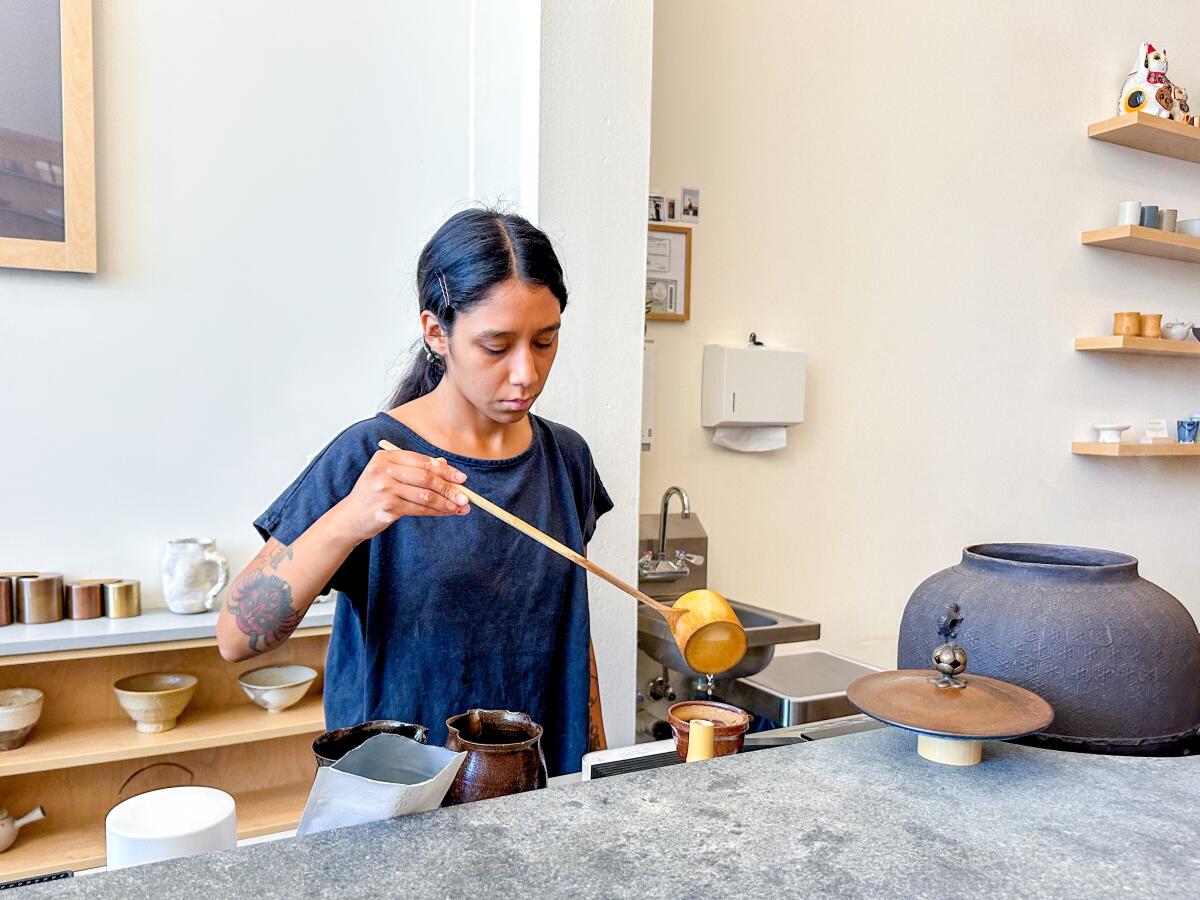
Step into Kettl, a new Japanese tea café in Los Feliz, and the contrast with global headlines is striking. The two-story café exudes calm. Customers sip matcha cortados served in rustic ceramic cups or select from lattes crafted with distinct flavor profiles — nutty, chocolaty, floral, or deeply umami. Sparkling iced matcha provides a lighter option, while staff-led tastings invite customers into a broader tea journey.

“I brewed it and was captivated by how much flavor was packed inside my tiny cup,” wrote Zach Mangan, Kettl’s founder, in his 2022 book Stories of Japanese Tea.

Mangan’s story reflects the path of many tea enthusiasts who become lifelong devotees. A jazz drummer in his twenties, he first encountered Japanese sincha while touring in Paris. Its aroma reminded him of freshly mowed grass, though he had never tasted it before. That single cup led him to years of travel in Japan, building connections with farmers and eventually becoming a respected importer.

From Brooklyn to Los Angeles

Mangan and his wife Minami opened Kettl’s first shop in Brooklyn in 2021. The Los Angeles location, delayed by permit and construction hurdles, finally opened in February 2025.

“Freshness changes everything,” Mangan explained in an interview. “The closer you are to the source, the more alive the tea becomes.”

Now, Kettl offers Angelenos not just matcha but also a carefully curated lineup of Japanese teas. The café hosts ticketed classes upstairs, covering topics like making iced matcha in summer. Its tasting bar, seating just four people, offers more intimate experiences. Prices start at $15 for a bowl of matcha, $10 for multi-steeping pots of other teas, and $70 for an omakase-style tea tasting.

L.A.’s Emerging Tea Culture

The matcha shortage 2025 underscores the fragility of global supply, yet in Los Angeles, tea culture is quietly flourishing. While bubble tea and casual matcha shops dominate, more specialized venues are carving out space.

Alhambra’s Tea Habitat offers by-appointment tastings of dan cong oolong, one of China’s most aromatic teas. Japanese-born consultant Tomoko Imade Dyen hosts seasonal tea tastings paired with food. Downtown’s The Good Liver also sells high-grade matcha, which often sells out quickly.

Against this backdrop, Kettl’s serene setting and regular imports from Japan feel unique. For many, it is not just a café but a window into the depth and diversity of Japanese tea.

Beyond Matcha: Exploring Sencha, Gyokuro, and Oolong

While matcha remains the star, Kettl is introducing customers to other Japanese teas. During tastings, Mangan compares the variety of sencha styles to French red wines or Scottish whiskies — diverse, complex, and deeply regional.

One offering, Hachiju Hachiya from Yame, delivered flavors of fresh edamame. Another, Hatsutsumi from Fukuoka, carried aromas reminiscent of Los Angeles after spring rain, with a buttery texture.

Kettl also features gyokuro, a shade-grown tea brewed with cooler water, producing sweet, ocean-like notes. Staff member Ashley Ruiz joked that the tasting notes for one rare gyokuro “were so enthusiastic, I knew Zach wrote them.” The flavor, she added, was almost like crabmeat.

And while Japanese oolong remains rare, Kettl provides a few select batches, described as light, expressive, and fruit-forward.

The Future of Matcha and Tea Culture

The matcha shortage 2025 highlights both the vulnerability of global tea supply chains and the resilience of tea culture. For enthusiasts, the shortage is not simply a crisis but an opportunity to explore new flavors.

Inside Kettl, groups gather around shared tables, sipping tea and engaging in long conversations. Some are there for the viral matcha craze; others discover sencha, gyokuro, or oolong for the first time.

As Mangan notes, “Tea is never just about the drink. It’s about the experience, the culture, and the connection it creates.”

For now, Los Angeles’ tea scene — though still niche — is expanding in exciting directions. And while the world grapples with the matcha shortage 2025, cafés like Kettl prove that tea culture is still very much alive, evolving, and ready for the future.

The matcha shortage 2025 is more than just a supply challenge — it reflects how global demand, climate pressures, and cultural trends collide. While wholesale prices soar and Japan struggles with reduced yields, tea enthusiasts are turning their attention not only to matcha but also to the broader spectrum of Japanese teas like sencha, gyokuro, and oolong. Cafés such as Kettl in Los Angeles show that despite shortages, the culture of tea is expanding, offering both comfort and discovery. The future of matcha may be uncertain, but the fascination with Japanese tea is only deepening.

Appreciating your time:

We appreciate you taking the time to read our most recent article! We appreciate your opinions and would be delighted to hear them. We value your opinions as we work hard to make improvements and deliver material that you find interesting.

Post a Comment:

In the space provided for comments below, please share your ideas, opinions, and suggestions. We can better understand your interests thanks to your input, which also guarantees that the material we offer will appeal to you. Get in Direct Contact with Us: Please use our “Contact Us” form if you would like to speak with us or if you have any special questions. We are open to questions, collaborations, and, of course, criticism. To fill out our contact form, click this link.

Stay Connected:

Don’t miss out on future updates and articles.

San Diego Schools Crack Down on Student Cell Phones Under New Rules

Students returning to campuses across the San Diego Unified School District this week are stepping into a new academic year — and a new set of rules for their mobile devices.

Beginning Monday, the first day of the 2025–2026 school year, the district’s mobile phone policy officially went into effect. The change comes after the Board of Education voted last month to approve guidelines they say are designed to “help minimize student distractions, elevate academic performance and prioritize students’ mental health and well-being.”

District officials note the policy was “developed in accordance with California’s Phone-Free School Act,” a law passed to encourage campuses to reduce device-related interruptions in learning environments. They also emphasize that the process included “significant input from students, parents, and educators” before the final rules were adopted.

📌 Story Highlights

  • In line with California’s Phone-Free School Act.

  • Applies to Transitional Kindergarten through 12th grade.

  • Phones off and out of sight during school hours.

  • Use allowed before/after school, on buses, and in extracurriculars.

  • High school students may use devices during lunch and passing periods.

  • Exceptions for emergencies, approved lessons, and special needs.

  • Step-by-step enforcement: verbal reminders, counselor referrals, parent contact, confiscation.

  • Repeat violations may lead to restrictions from school activities.

The district-wide rules apply to every grade level, from the youngest Transitional Kindergarten students to graduating seniors. Under the new guidelines, phones must be completely turned off and kept out of sight during regular instructional hours.

Students are still free to use their devices before the morning bell, after dismissal, while traveling on school buses, and during extracurricular programs. For high school students, there is an added window of flexibility — phones can be used during lunch breaks and between classes during passing periods.

Recognizing that some situations call for exceptions, the policy permits device use in emergencies, when authorized by teachers for instructional purposes, or when needed to accommodate special needs.

Enforcement, officials say, will not rely on immediate punishment but on what they describe as a “Positive Behavior Interventions and Supports + Restorative Justice Practices approach.” This begins with a verbal reminder, followed by a counselor referral if necessary. Continued violations may prompt parent contact, and ultimately, confiscation of the phone.

The district warns that persistent noncompliance could result in students being barred from attending certain school events and activities — a step administrators hope will not become necessary.

“Phones have a place in students’ lives, but not at the cost of focus, learning, and well-being,” one board member remarked during the vote last month. “This policy strikes that balance.”

As the new academic year unfolds, San Diego Unified’s mobile phone policy marks a clear shift toward reclaiming classroom focus and protecting student well-being. By blending strict rules with gradual, restorative enforcement, district leaders hope to reduce distractions without alienating students. Whether this approach fosters a healthier, more engaged learning environment will likely become clear in the months ahead, as educators, parents, and students adjust to the new rhythm of a phone-limited school day.

Appreciating your time:

We appreciate you taking the time to read our most recent article! We appreciate your opinions and would be delighted to hear them. We value your opinions as we work hard to make improvements and deliver material that you find interesting.

Post a Comment:

In the space provided for comments below, please share your ideas, opinions, and suggestions. We can better understand your interests thanks to your input, which also guarantees that the material we offer will appeal to you. Get in Direct Contact with Us: Please use our “Contact Us” form if you would like to speak with us or if you have any special questions. We are open to questions, collaborations, and, of course, criticism. To fill out our contact form, click this link.

Stay Connected:

Don’t miss out on future updates and articles.

Chicago’s Sundays on State Shakes Up the Calendar with Fall Festivities

Chicago’s popular street festival, Sundays on State, known for transforming the city’s famous State Street into a vibrant block party, is making a notable change this year. Traditionally held during the summer months, the event has shifted its schedule to two Sundays this fall — September 7 and October 5 — from 11 a.m. to 6 p.m. The change offers attendees a fresh seasonal experience while keeping the festival’s signature lively atmosphere intact.

Story Highlights

  • Sundays on State festival shifts from summer to fall dates: September 7 and October 5, 11 a.m. to 6 p.m.

  • State Street from Randolph to Jackson will be closed to traffic to create a safe pedestrian zone

  • Festival features nearly 400 vendors, live performances, and local food vendors

  • More than one million visitors since 2021, expect large crowds

  • Free entry with online registration and chance to win a $1,000 Loop Staycation Package

  • Festival supports economic recovery and complements other major downtown summer events

The event is hosted by the Chicago Loop Alliance in partnership with the Chicago Department of Cultural Affairs and Special Events. For these two days, State Street will be closed off to traffic from Randolph Street to Jackson Boulevard, creating a safe and pedestrian-friendly environment where visitors can freely roam, explore, and participate in various activities. This closure allows the street to fully embrace its festival identity without the usual city hustle of vehicles.

Throughout the day, festival-goers can expect an engaging lineup of live performances featuring local talent such as the Chicago Movement Collective, Windy City Ramblers, and Rhythm Revolution. The festival is not only about music; it also highlights Chicago’s rich culinary scene. Food stalls from well-known local vendors like Bad Johnny’s Wood-Fired Pizza, Moor’s Brewing Company, and Taqueria La Ciudad will offer a diverse range of tasty options to satisfy all palates.

The shopping experience is equally impressive. Nearly 400 vendors will showcase an eclectic mix of goods — from handcrafted leather items and unique jewelry to luxury bath products and nostalgic retro video games. Attendees can also enjoy interactive attractions and special happenings scattered throughout the festival grounds. Since 2021, Sundays on State has attracted more than one million visitors, making it a major event in the city’s cultural calendar. Visitors should prepare for sizable crowds given its popularity.

Michael Edwards, President and CEO of the Chicago Loop Alliance, offered insights into the festival’s growth and timing. He explained, “What started as an initiative to support the Loop’s economic recovery post-pandemic has transformed into one of the city’s marquee events.” He added that moving Sundays on State to the fall aligns well with the Alliance’s efforts to support other major downtown summer events such as Lollapalooza and the NASCAR Chicago Street Race. This strategic scheduling ensures that the city’s summer events calendar remains vibrant without overlapping large-scale activities.

The best news for attendees is that Sundays on State remains completely free and open to the public. By registering online, visitors can also enter a drawing for a $1,000 Loop Staycation Package, adding an exciting incentive to attend. Those interested in planning their visit can find a full lineup of performances, vendors, and food options through the official event website.

As Chicago prepares to welcome this refreshed edition of Sundays on State, the festival promises to be a celebration of community, culture, and commerce, showcasing the best of what the city has to offer in a pedestrian-friendly, open-air setting.

Sundays on State’s move to the fall season marks an exciting new chapter for this beloved Chicago event. By offering a safe, vibrant, and diverse celebration of local culture, food, and art, the festival continues to strengthen the Loop community and support the city’s economic recovery. With free entry, a wide range of activities, and the chance to win exclusive prizes, this fall edition invites Chicagoans and visitors alike to come together and enjoy everything the city’s iconic State Street has to offer—this time, with the crisp air of autumn adding a fresh vibe to the festivities.

Appreciating your time:

We appreciate you taking the time to read our most recent article! We appreciate your opinions and would be delighted to hear them. We value your opinions as we work hard to make improvements and deliver material that you find interesting.

Post a Comment:

In the space provided for comments below, please share your ideas, opinions, and suggestions. We can better understand your interests thanks to your input, which also guarantees that the material we offer will appeal to you. Get in Direct Contact with Us: Please use our “Contact Us” form if you would like to speak with us or if you have any special questions. We are open to questions, collaborations, and, of course, criticism. To fill out our contact form, click this link.

Stay Connected:

Don’t miss out on future updates and articles.