Staff Reporter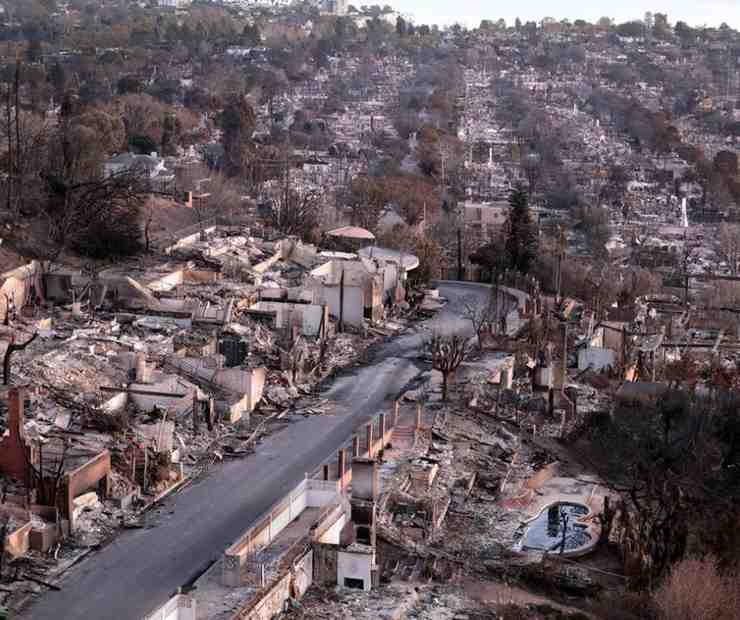
A pair of crises are converging in Los Angeles County. Congress has cut $3.4 million in federal funding for LAist, threatening the nonprofit newsroom’s ability to cover local affairs. At the same time, the county is grappling with how — and where — to rebuild after January’s destructive fires.
One of the biggest flashpoints is California’s SB 9 housing law, which allows homeowners to split lots and add duplexes or up to four units on land previously zoned for a single house. Supporters call SB 9 a lifeline for fire-hit families. Opponents call it dangerous densification in high-risk burn zones.
Story Highlights
-
Funding cut: LAist loses $3.4 million over two years after Congress reduces public-media support.
-
Key law: SB 9 housing law lets owners rebuild duplexes or multiple units on single-family parcels.
-
Divided response: Mayor Karen Bass banned SB 9 projects in the Pacific Palisades; Altadena leaders left the option open.
-
Applications: 26 SB 9 rebuild requests filed in Altadena; seven were filed in the Palisades before the ban.
-
Safety vs. equity: Critics cite evacuation risks; backers cite financial survival and multigenerational housing.
A Law Few Used — Until the Fires
Since taking effect in 2022, the SB 9 housing law had been a quiet experiment. Costly and tightly regulated, it was seldom invoked. That changed after January’s wildfires destroyed more than 13,000 homes.
Now, dozens of burned-out homeowners are filing SB 9 applications. Seven went in at the Pacific Palisades before Mayor Karen Bass halted the practice. In Altadena, 26 applications had arrived by early September.
Mayor’s Ban vs. County’s Openness
Bass acted soon after Governor Gavin Newsom gave local leaders the power to suspend SB 9 in very high fire-hazard areas. Her administration argued that adding more homes, and more people, would strain roads and emergency response during the next disaster.
County leaders in Altadena took the opposite tack. “I don’t want to disenfranchise anyone from the ability to rebuild,” said Supervisor Kathryn Barger, who represents the area. “We have the flexibility at the local level to address what SB 9 is doing without taking away local land rights.”
Balancing Safety and Survival
Barger generally opposes state laws overriding local zoning. Yet she praised Newsom for restricting high-density development on Altadena’s Fair Oaks and Lake Avenue corridors after the Eaton Fire.
At the same time, she said SB 9 gives burned-out homeowners a financial foothold. “I want people to be able to choose to rebuild because they want to,” Barger said. “I want to make sure I don’t put any hurdles in place.”
Under SB 9, owners can rent secondary units or pool resources with relatives on the same lot — a chance to stay in their community rather than sell and leave.
Rebuilding a Legacy
For Paul Sanchez of Altadena, the SB 9 housing law may be the only way forward. Before the fire, his family lived in a classic post-war modernist home with steel framing and floor-to-ceiling windows — designed by an architect who fled Vienna after the Holocaust.
“The home that I lived in was built with new materials and new ideas at the time in 1948,” Sanchez recalled. “I’m going to continue this legacy of new ideas.”
He is exploring pre-fabricated, fire-resistant models and plans to keep units small and affordable for renters and for himself and his wife. “I’m cautiously optimistic,” he said, standing on the dirt lot. “I think SB 9 is an option that could really help me. Because I’m not sure if I can do it without it.”
Multigenerational Solutions
Nonprofit Neighborhood Housing Services of L.A. County is advising homeowners on rebuilding. CEO Lori Gay said SB 9 is complex but can work, especially for long-term, cash-strapped residents.
Her staff gently urges owners to keep properties in the family. “Do you have someone else in your family that either you’d consider selling to, or parcel-splitting with?” they ask.
Often, seniors are willing to move into smaller spaces while letting relatives occupy the main home. “As we think about rebuilding now, is that something that’s workable for people?” Gay said.
Critics Mobilize Online
Opponents have taken their case to social media. Before Bass suspended the law in the Palisades, influencer Spencer Pratt posted viral TikToks attacking leaders for allowing duplexes. He said the area “cannot handle more density.”
Christopher LeGras of Our Neighborhood Voices, a group opposed to state-imposed density, warned of evacuation hazards. “The idea of putting in more people who would have to evacuate if — God forbid — there’s another major emergency, is just reckless,” he said.
Opponents also fear SB 9 will change the character of low-density blocks. “When you start talking duplexes and real, more substantial multifamily [homes], I think that’s a bridge too far,” LeGras said.
Mild Density Gains So Far
None of the Altadena applications seek full lot splits or the four-unit maximum. Most propose only one additional unit. Barger has asked the county’s Public Works Department to study the impact of higher-density projects but is leaving SB 9 available for now.
Malibu has also refrained from banning SB 9 and reports no applications. Developer Andrew Slocum, who helps Altadena homeowners, said most use SB 9 to add just one unit but get better property valuations than through accessory dwelling unit (ADU) laws.
He criticized Bass’s decision as a “knee-jerk reaction” that “robbed” Palisades homeowners of rebuilding options.
Governor’s Order Still in Play
Newsom’s executive order gave local leaders the choice to suspend SB 9 in high fire-hazard burn zones. It does not cover all of Altadena, but officials could still restrict the law in the community’s eastern foothills.
Independent Journalism Under Pressure
As LAist documents the fallout of the SB 9 housing law in fire-zones, its own future is uncertain. The loss of $3.4 million in federal funds jeopardizes its paywall-free reporting on housing, climate and the homelessness crisis.
The newsroom is appealing to readers for support. It argues that no matter one’s politics, press freedom and independent local journalism are vital to keeping communities informed.
Appreciating your time:
We appreciate you taking the time to read our most recent article! We appreciate your opinions and would be delighted to hear them. We value your opinions as we work hard to make improvements and deliver material that you find interesting.
Post a Comment:
In the space provided for comments below, please share your ideas, opinions, and suggestions. We can better understand your interests thanks to your input, which also guarantees that the material we offer will appeal to you. Get in Direct Contact with Us: Please use our “Contact Us” form if you would like to speak with us or if you have any special questions. We are open to questions, collaborations, and, of course, criticism. To fill out our contact form, click this link.
Stay Connected:
Don’t miss out on future updates and articles.