Staff Reporter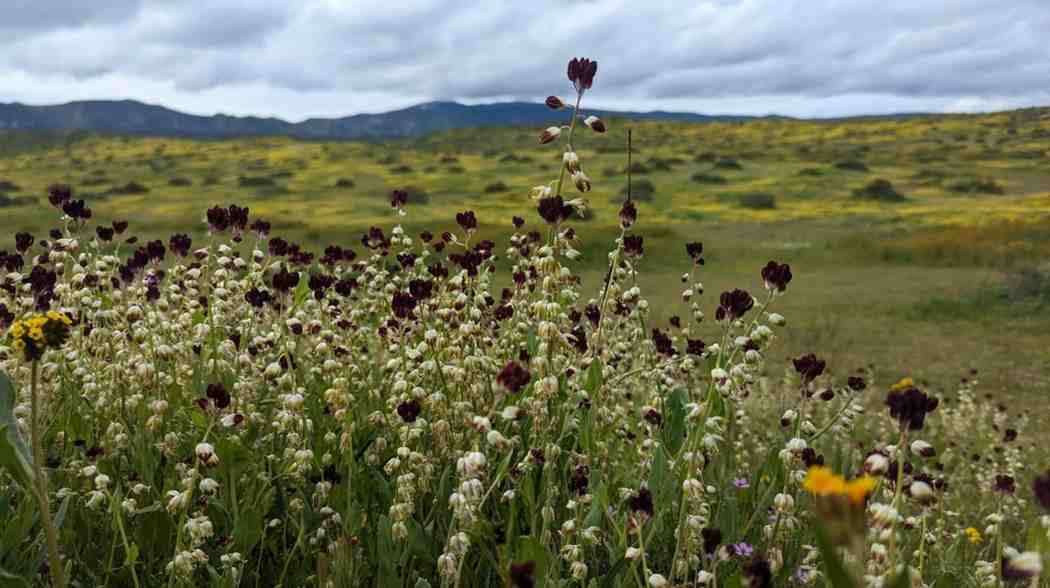
The small, bell-shaped blooms that sway like tiny jewels in the breeze give jewelflowers their evocative name. In dazzling shades of yellow, maroon, purple, brown and white, these plants light up the Sierra foothills, arid deserts, coastal bluffs and grasslands of California. Despite their exotic appearance, jewelflowers belong to the humble mustard family.
More than 60 species are scattered across the state. Some have incredibly restricted ranges. Farnworth’s jewelflower (Streptanthus farnsworthianus) grows only in the Sierra foothills. The striking Mount Tamalpais jewelflower (Streptanthus batrachopus) clings to the slopes of a single peak just north of San Francisco. Such endemism makes these wildflowers both captivating and vulnerable.
📌 Story Highlights
-
Jewelflowers (Streptanthus and Caulanthus) are endemic California wildflowers, with many species found only in one location.
-
They originated in arid southwestern deserts 2–5 million years ago and spread north into California’s Mediterranean climate.
-
A new study shows jewelflowers survive by altering their germination and flowering schedules rather than evolving new climate tolerances.
-
Seeds sprout after first rains, then bloom during the hottest, driest part of the year — regardless of region.
-
High habitat specificity leaves many species endangered and at risk from climate change.
A Long Journey From the Desert
The evolutionary story of jewelflowers stretches back millions of years. These plants began in the arid deserts of the Southwest and slowly moved north, establishing themselves from Baja California to Oregon. They now thrive in environments that seem far removed from their desert origin, including cooler, wetter regions of California’s Mediterranean climate.
For decades, botanists assumed this expansion was powered by classic adaptation — that jewelflowers evolved to tolerate a wide range of temperatures and rainfall. But a new study has upended that assumption.
Changing the Schedule, Not the DNA
Researchers discovered that jewelflowers’ real secret lies not in genetic overhaul but in the timing of their lives.
“Jewelflowers are really amazing plants,” said Megan Bontrager, study co-author and botanist at the University of Toronto.
She continued:
“It’s one of the groups of flowers that have figured out how to complete their life cycle under the constraints of that super dry spring and summer.”
The team examined 14 species and found a striking pattern. All of them — whether in hot deserts or cooler northern hills — germinated after the first rains and flowered during the driest, hottest part of the year. Even in mild regions, jewelflowers actively sought drought-prone soils with poor water retention, echoing the deserts of their ancestry.

Evidence Hidden in Herbarium Drawers
The researchers based their findings on nearly 2,000 herbarium specimens from the Consortium of California Herbaria. Each specimen included the location and date of collection. When paired with historic climate data, the records allowed scientists to reconstruct when the plants sprouted and how old they were.
The result was a clear picture: regardless of geography, jewelflowers consistently synchronized their life stages with the onset of heat and dryness.
Vulnerability in a Warming World
This survival tactic has limits. Many jewelflower species are already threatened. The California jewelflower (Caulanthus californicus) and the Tiburon jewelflower (Streptanthus glandulosus niger) are listed as endangered due to habitat loss, overgrazing, urban development and pollinator decline.
As climate change reshapes California, scientists expect the first rains — the vital cue for jewelflower germination — to arrive later in the year. This would compress the plants’ already tight growing window.
“If they can’t flower in time and produce seeds, fewer and fewer plants will appear in subsequent years,” Bontrager warned.

Pollinators Out of Sync
There is also the risk of a timing mismatch with pollinators. If insects emerge earlier than the jewelflowers bloom, fewer seeds may be produced. Such mismatches have been documented in other plant–pollinator systems and could accelerate declines.
Isabela Lima Borges, an expert in rare plants at the Santa Barbara Botanic Garden who was not involved in the study, underscored the implications:
“This study shows how creatively using natural history collections can reveal the ecological limits of rare plants. These flowers may look widespread but still have very specific needs.”
Preserving Refuges
With intense heat waves, prolonged droughts, extreme rainfall and larger wildfires already altering California’s landscapes, protecting the refuges where jewelflowers can persist may be the only way to secure their future. Conservationists argue that understanding their unique survival strategy is a first step toward safeguarding these rare gems of the state’s flora.
Jewelflowers may have learned to adjust their clocks, but in a rapidly changing climate, even their finely tuned timing could be tested.